
The science
The molecular science of IP6.
Explore the mechanisms studied in IP6 and inositol research, from iron-binding chemistry to the regulation of cellular behavior.
Antioxidant chemistry
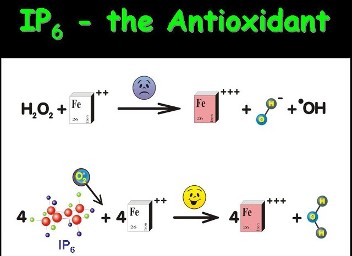
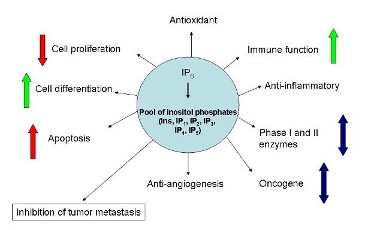
IP6 can bind iron, a property central to its study as an antioxidant. In the Fenton reaction, ferrous iron reacts with hydrogen peroxide to generate highly reactive hydroxyl radicals. These radicals can damage DNA, proteins, and lipids.
By binding iron, IP6 can alter the chemistry that produces those radicals in experimental systems. This mechanism has motivated research into oxidative injury and cellular protection.
The biology is context-dependent. Oxidative processes also participate in immune defense. Research cited in the original collection examined inositol phosphates and superoxide production in neutrophils, immune cells that respond to microbes.
Cell growth and differentiation
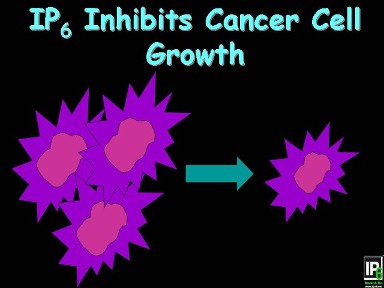
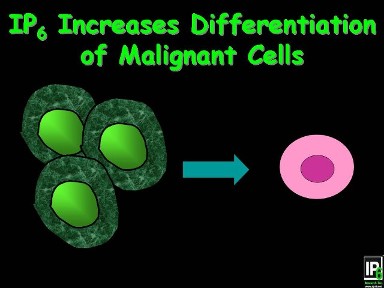
Cancer research has investigated whether IP6 and inositol influence uncontrolled proliferation and the differentiated characteristics of malignant cells. Differentiation is the process by which cells acquire specialized features and functions.
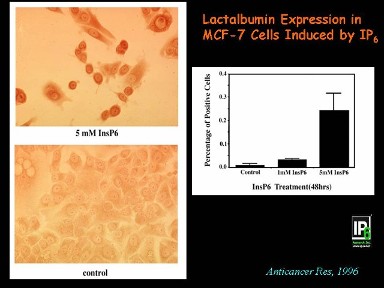
The original collection illustrates a study in MCF-7 human breast cancer cells. Following exposure to IP6, investigators reported fewer cells and increased lactalbumin production, a marker associated with mammary epithelial differentiation. The original panels show staining and the concentration-dependent changes measured in the experiment.
Other research examined apoptosis at higher concentrations. Effects on proliferation, differentiation, and cell death should be interpreted separately and in the context of each experimental model.
Inositol phosphates and cell signaling
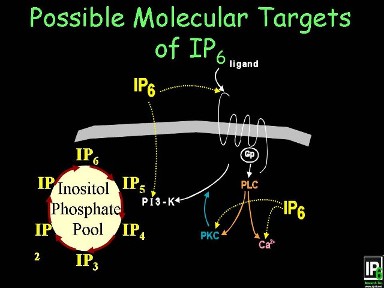
IP6 sits within a broader family of inositol phosphates. Enzymatic reactions can remove phosphate groups to produce lower inositol phosphates, or generate more highly phosphorylated compounds such as IP7 and IP8.
The original site discusses possible roles for cell-surface binding, receptor-mediated activity, and intracellular calcium signaling. It also notes that the fate and function of IP6 entering intracellular inositol phosphate pools require further investigation.
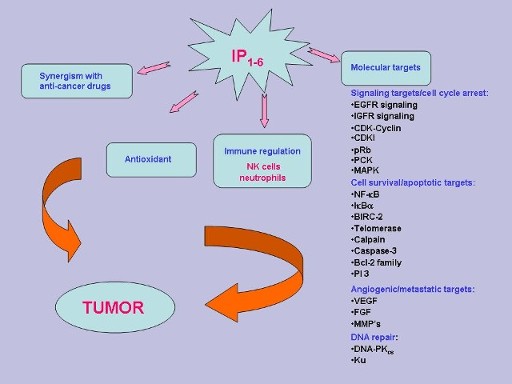
Research has examined regulators including p53, p27, PI3K, NF-κB, PKCδ, retinoblastoma protein, Akt, and ERK1/2. These pathways help regulate cell growth, survival, and other cellular behaviors. A pathway association is a starting point for understanding mechanism, rather than proof of a clinical outcome.
Angiogenesis and growth-factor interactions
Angiogenesis is the formation of new blood vessels. It is essential to normal biology and can also support tumor growth. IP6 has been investigated for effects on angiogenic processes.
The collection cites studies of antiangiogenic activity and research involving fibroblast growth factor 1 (FGF1). Interactions with growth factors may help explain some experimental effects, but their relevance depends on the biological setting.
Epigenetic regulation
Epigenetic regulation changes gene activity without changing the underlying DNA sequence. Relevant processes include DNA methylation, methylated-DNA binding, and histone modification.
Pandey and Gupta studied IP6 in a mouse lung model exposed to the carcinogen ethylnitrosourea (ENU). Their 2010 report examined DNMT1, MeCP2, MBD1, and HDAC1, molecules involved in epigenetic regulation. IP6 administration reduced several ENU-associated alterations.
The study contributes mechanistic evidence in an animal model. It does not establish an epigenetic treatment in humans.
Follow the scientific literature
Relevant publications may use several names for the same molecule: IP6, InsP6, inositol hexaphosphate, inositol hexakisphosphate, or phytic acid. Search terms influence which results appear.
The references below preserve the source collection’s scientific links and pathway searches. When reading a paper, consider whether it is a cell study, animal experiment, observational study, or clinical trial, and whether its formulation and conditions match the question you are asking.
Explore original research figures (7)
Historical figures preserved from ip-6.net. Read alongside the original publications for methods, experimental conditions, and interpretation. Select an image to view it at its original resolution.
Sources & references
Explore the publications cited in the original IP-6 Research collection. Some older journal links may redirect or require access through a library.
Inositol phosphates and neutrophil activityPubMed · PMID 1655041IP6 and differentiation of breast cancer cellsPubMed · PMID 9042302anti-angiogenesisOriginal journal referenceIP6 interactions with FGF1PubMed · PMID 21077672Epigenetic regulation in a mouse lung modelPubMed · PMID 21154115inositol hexaphosphate and p53PubMed literature searchinositol hexaphosphate and p27PubMed literature searchinositol hexaphosphate and pi3-kinasePubMed literature searchinositol hexaphosphate and nf kappa bPubMed literature searchinositol hexaphosphate and pkcPubMed literature search