
About us
The origins of IP6 research.
A sustained inquiry into IP6 and inositol, connecting molecular science with questions that matter to human health.
A focus on IP6 and inositol
IP-6 Research, Inc. is based in Lutherville, Maryland. Its research information collection brings together investigations into inositol and inositol hexaphosphate, with an emphasis on the work initiated by Professor AbulKalam M. Shamsuddin and expanded by researchers internationally.
The scientific story begins with molecules found in everyday biology. Inositol is a six-carbon cyclic polyol; IP6 is its derivative with six phosphate groups. IP6 occurs in seeds and grains, including rice, corn, wheat, soy, and sesame, and in mammalian cells. It is also called InsP6, phytic acid, or phytate, depending on its chemical form.
The original site described inositol as a B vitamin. Inositol is commonly described as a vitamin-like compound, rather than an essential B vitamin. Similarly, suggestions that IP6 might be a vitamin remain hypotheses, not an established classification.
From phytin to cellular research
Hartig identified the material later known as phytin in seeds in 1855–1856. Its molecular structure was elucidated in 1910. Naturally occurring phytin includes calcium and magnesium salts of inositol hexaphosphate.
Phytate has long attracted attention for its ability to bind minerals. Its historical description as an “anti-nutrient” prompted research on low-phytic-acid crops. The original collection cites work on genetic engineering, reduced-phytate maize, and the agronomic challenges of low-phytate mutants. These questions connect nutrition, crop biology, and molecular chemistry.
In 1985, experiments in Shamsuddin’s laboratory at the University of Maryland School of Medicine began investigating the anticancer activity of IP6 and inositol. Subsequent research explored cellular mechanisms, immune activity, and additional biological applications.
Cancer biology across experimental models
The original research collection describes investigations in breast, colon, liver, lung, prostate, leukemia, lymphoma, and sarcoma models. Researchers studied IP6 and inositol separately and together, measuring tumor development, cell proliferation, differentiation, and apoptosis.
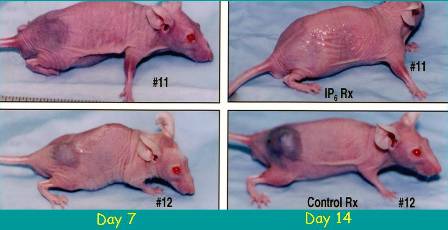
A liver cancer experiment cited by the original site reported tumor regression in a mouse model following IP6 treatment. This is an experimental result in animals, not evidence that IP6 treats liver cancer in humans.
Studies of differentiation examined whether malignant cells could acquire characteristics associated with more mature cells. The collection describes changes in mammary cell lactalbumin, prostate-specific antigen, and alpha-fetoprotein expression. At higher experimental concentrations, some studies also observed programmed cell death. Results depend on the model, concentration, and conditions.
Schroterova and colleagues at Charles University reported experiments in HT-29, SW-480, and SW-620 colorectal carcinoma cells in 2010. Their work compared IP6, inositol, and the combination using metabolic activity, DNA synthesis, protein synthesis, and apoptosis measurements. Inositol increased the proapoptotic effect of IP6 in the tested cell lines.
The role of immune activity
Natural killer (NK) cells are immune cells that can recognize and destroy abnormal cells. Work cited in the original collection examined the effect of IP6 and inositol on NK activity in experimental systems, including tumor-bearing animals.
The original studies reported enhanced NK activity with the compounds, including their combination. A later paper by Zhang and colleagues investigated IP6 and NK cell activity. These observations contribute to a mechanistic research question; they do not establish a general immune-boosting benefit in people.
From laboratory observations to human studies
The original site described reports presented at the 7th International Conference of Anticancer Research in Corfu, Greece, on October 25–30, 2004. These included colon, lung, and breast cancer cases in which IP6 and inositol were used with or without conventional treatment. The conference material reported treatment responses, side effects, and quality-of-life observations.
The conference archive included a CT example involving liver metastases from colon cancer. Individual case images and conference reports have important limitations: they cannot establish causation or substitute for controlled trials.
A subsequent randomized pilot study in 14 breast cancer patients, published in 2010, compared IP6 plus inositol with placebo during chemotherapy. It reported differences in quality of life, functional status, and some blood-count outcomes. Its small sample size means larger studies are needed. The Insights section presents this paper alongside other work on combinations with standard agents.
An April 7, 2010 NBC Nightly News report referenced by the original site discussed an inositol lung cancer investigation. That historical media report should be distinguished from primary clinical evidence.
A documented history of invention
The source collection links U.S. Patent 5,082,833 concerning IP6 and inositol, together with three later patents associated with IP6 citrate compounds. These documents preserve the history of the research and proposed applications. A patent is not clinical evidence or regulatory approval for a medical treatment.
Original documents
Explore original research figures (4)
Historical figures preserved from ip-6.net. Read alongside the original publications for methods, experimental conditions, and interpretation. Select an image to view it at its original resolution.



Sources & references
Explore the publications cited in the original IP-6 Research collection. Some older journal links may redirect or require access through a library.
IP6 in experimental human liver cancerPubMed · PMID 9891450IP6 and natural killer cell activityPubMed · PMID 16124063IP6 and inositol in colorectal carcinoma cell linesPubMed · PMID 20127021