
Research areas
Areas of investigation.
Explore the biological systems and experimental models that have shaped the IP6 and inositol research collection.
Neuroscience and neuroprotection
The original collection discusses Alzheimer’s disease, Parkinson’s disease, and multiple sclerosis as areas of IP6-related investigation and patent proposals. These topics should be understood as research interests, rather than established therapeutic uses.
Work from Manju Reddy’s laboratory reported neuroprotective effects in a Parkinson’s disease cell-culture model. Research associated with Felix Grases proposed a relationship between IP6 availability and Alzheimer’s disease, and a paper published in 2011 examined IP6 in experimental Alzheimer’s models.
JoAnne McLaurin and colleagues at the University of Toronto studied inositol interactions with amyloid-beta and its aggregation and toxicity. Findings for a particular inositol form or model should not be generalized to every inositol compound or to people with neurodegenerative disease.
A 2025 laboratory study by Samantha Godoy, Miquel Adrover, and colleagues at the University of the Balearic Islands in Spain examined IP6 as a chelator of ferric iron, a metal whose dysregulation is implicated in both Parkinson’s and Alzheimer’s disease. In aqueous solutions, IP6 slowed the iron-catalyzed oxidation of dopamine and ascorbic acid and changed the course of iron-induced alpha-synuclein aggregation, favoring fibrils over the oligomeric forms the authors consider more toxic. The paper also summarizes earlier reports of IP6 inhibiting the BACE1 enzyme and amyloid-beta accumulation in Alzheimer’s disease models.
These are test-tube chemistry findings rather than results in animals or people. The authors note that IP6 bioavailability, its passage across the blood-brain barrier, and the dose-response relationship in neurodegeneration remain open questions.
Kidney stones and mineral crystallization
The collection traces this area to work by Philip Henneman and colleagues at Harvard Medical School and Massachusetts General Hospital in 1958, followed by later investigations by Felix Grases and collaborators.
These studies explored phytate, urinary chemistry, and the formation of mineral crystals. Other work described phytate measurements in human plasma and urine, and changes associated with diet.
The original site proposed that IP6 might qualify as a vitamin. That proposal remains distinct from an established nutritional classification. Experimental crystal-inhibition findings also do not by themselves establish a kidney stone treatment.
Cardiovascular biology
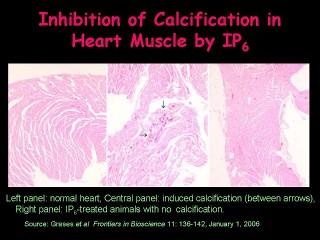
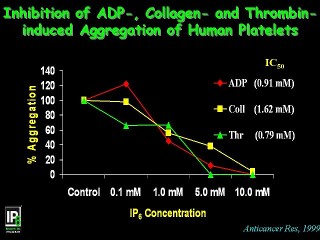
Cardiovascular investigations cited in the collection examine pathological calcification, platelet aggregation, and reperfusion injury. These are different biological processes and require different forms of evidence.
Grases and colleagues investigated phytate in relation to abnormal mineral deposition in soft tissues and blood vessels. Separate work examined IP6 and platelet aggregation. Another line of investigation considered oxidative damage when blood flow returns to previously deprived heart tissue.
These mechanisms are relevant to cardiovascular research, but the findings do not establish that an oral IP6 supplement prevents heart attacks or strokes.
Prostate, blood, and vascular cancer models
Diallo and colleagues in Montreal studied combinations of IP6 and proteasome inhibitors in androgen-independent prostate cancer cells. The original collection also points to subsequent work from that group and research from Rajesh Agarwal’s laboratory at the University of Colorado.
H. C. Tran and colleagues at the University of Maryland reported work on Kaposi’s sarcoma and adult T-cell lymphoma cells at the American Association for Cancer Research meeting in 2003. Their experiments examined tumorigenic and angiogenic activity in vitro.
A 2002 paper from Giorgio Lambertenghi Deliliers and colleagues at the University of Milan examined IP6 in human myeloid leukemia cell lines and fresh chronic myeloid leukemia progenitor cells. The researchers reported concentration-dependent effects and compared them with normal hematopoietic cells. These were laboratory observations, not clinical treatment outcomes.
Glucose metabolism and diabetes research
Experiments reported by Hoy and colleagues in 2003 investigated insulin secretion in isolated murine pancreatic beta cells. Dilworth and colleagues studied dietary IP6 and blood glucose in rats.
Soo Mi Kim and colleagues at Kyungpook National University examined IP6 in C57BL/6N mice receiving a high-fat diet. Their 2010 study assessed glucose-metabolizing enzymes, blood glucose, hepatic glycogen, and body weight.
The source collection also cites work by Nascimento and colleagues on inositol and oxidative mechanisms in experimental diabetic complications. These distinct studies provide research leads. They do not establish that the combination treats human diabetes or reverses its complications.
Radiation and cellular protection
This area examines cellular injury associated with ultraviolet and ionizing radiation. A 2007 report by Cebrian and colleagues at CIEMAT in Madrid studied IP6 binding of uranium, suggesting a potential application for further investigation.
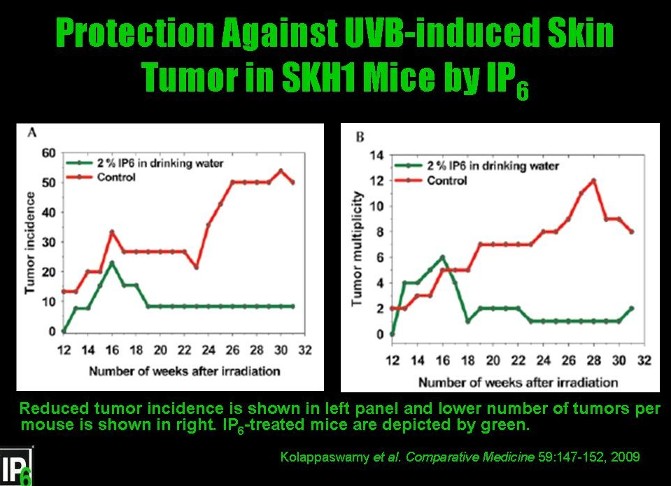
Shamsuddin and colleagues presented laboratory work on IP6, inositol, and radiation-related cell injury at the 2007 AACR Centennial Meeting in Singapore. Other experiments investigated ultraviolet-induced skin tumors in mice and responses in human HaCaT keratinocyte cultures, including a 2011 report by Williams and colleagues.
The collection includes a radiation-related patent application. Neither that proposal nor laboratory results establish protection for people exposed to radiation, and they should not be used to guide radiation treatment or emergency care.
Bone and dental research
The source site describes experiments on osteoblasts and osteoclasts, the cells involved in bone formation and resorption. It also cites epidemiological studies and research in postmenopausal women examining phytate intake and bone-related outcomes.
Dental research examined the acidity of soft drinks, dental erosion, and the effects of phytate under experimental conditions. These lines of work appear in the Insights archive with their original references and figures.
Explore original research figures (3)
Historical figures preserved from ip-6.net. Read alongside the original publications for methods, experimental conditions, and interpretation. Select an image to view it at its original resolution.
Sources & references
Explore the publications cited in the original IP-6 Research collection, together with more recent research added to this page. Some older journal links may redirect or require access through a library.
On the potential role of phytate against neurodegeneration: protection against iron-catalyzed degradation of dopamine and ascorbate and iron-induced protein aggregation (Godoy, Sanchis, Frau, Vilanova & Adrover, 2025)Open-access article · Int. J. Mol. Sci. 26:4799 · PMID 40429940Neuroprotection in a Parkinson’s disease cell modelPubMed · PMID 18255213deficiency of IP6 could be a risk factor for Alzheimer's diseaseOriginal journal referenceIP6 in experimental Alzheimer’s disease modelsPubMed · PMID 20930278inositol treatment for AD patients may help to prevent A -deposition and A -induced toxicityOriginal journal reference1958 (!)Original journal referencePhytate and kidney stone formationPubMed · PMID 17127264Phytate and cardiovascular calcificationPubMed · PMID 18508720IP6 and platelet aggregationPubMed · PMID 10625941IP6 and myocardial reperfusion injuryPubMed · PMID 1929656IP6 and proteasome inhibition in prostate cancer cellsPubMed · PMID 18941459Full-text research article · PMC3356122PubMed CentralProfessor Rajesh AgarwalOriginal journal referenceIP6 in human myeloid leukemia cellsPubMed · PMID 12028025IP6 and insulin secretion in pancreatic cellsPubMed · PMID 12837755Dietary phytic acid and blood glucose in ratsPubMed · PMID 15999878IP6 and glucose metabolism in micePubMed · PMID 20664725Inositol and experimental diabetic complicationsPubMed · PMID 16373499IP6 binding of uraniumPubMed · PMID 17627956Full-text research article · PMC2703150PubMed CentralFull-text research article · PMC3060432PubMed Central