
Research insights
Research archive.
Selected developments from the original research archive, presented with their scientific context and supporting documents.
The IP6 citrate compounds
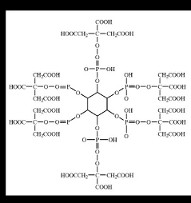
The original collection introduces IP6 citrate compounds, or IP6cit, formed by linking citrate groups to the phosphate groups of IP6. The proposed structures were described in U.S. Patents 7,009,067, 7,517,868, and 7,989,435.
The site describes additional potential cation-binding sites in IP6 hexacitrate compared with IP6, motivating hypotheses about chelation and antioxidant behavior. Such proposed properties require experimental validation; they do not establish that these compounds are superior therapies.
A related research question concerns phosphorus utilization in non-ruminant animals. The collection cites work on adding citric acid to poultry feed and improving phytate phosphorus utilization. It proposes that IP6cit could have agricultural and environmental applications, including reducing phosphorus waste. Those proposed uses are distinct from the cited feeding experiment.
Bone remodeling and dental erosion
The original site groups bone and dental investigations around mineral chemistry. It describes the balance between bone-forming osteoblasts and bone-resorbing osteoclasts, and experiments studying the effects of IP6 and inositol on these cells.
It also cites observational work on dietary phytate and bone mineral density, including studies in postmenopausal women. Associations between diet and bone outcomes should not be treated as proof that one compound prevents osteoporosis.
Dental work examines the erosive properties of acidic beverages and the effects of phytate in experimental settings. The underlying research should be consulted for formulation, conditions, and clinical relevance.
Interactions with other anticancer agents
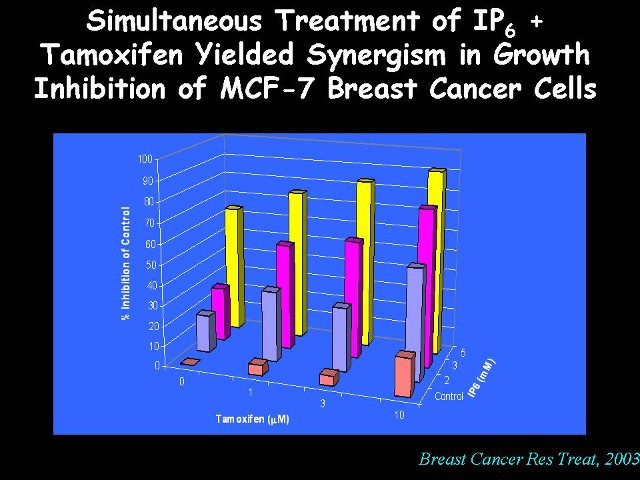
Tantivejkul and colleagues investigated IP6 alongside adriamycin and tamoxifen in human breast cancer cell lines, including resistant or estrogen-receptor-negative models. Their 2003 paper reported enhanced antiproliferative effects under the experimental conditions.
A 2009 melanoma-cell study examined IP6 combined with pterostilbene and reported synergistic growth inhibition. These laboratory combinations do not establish effective or safe treatment combinations for patients.
The collection also cites Kawanishi and colleagues on the complex role of antioxidants in cancer-related oxidative damage. A compound’s antioxidant activity alone cannot predict its clinical benefits or its interactions with treatment.
Quality of life during chemotherapy
Bacic and colleagues at General Hospital Zadar in Croatia conducted a prospective randomized pilot study of 14 patients with invasive ductal breast cancer receiving chemotherapy. Participants were assigned to IP6 plus inositol or placebo.
The study reported better quality-of-life and functional-status scores in the intervention group. It also reported differences in leukocyte and platelet counts, while red blood cell counts and tumor markers were unchanged in both groups.
Published in the Journal of Experimental & Clinical Cancer Research in February 2010, this small pilot provides a reason for further study. It does not establish that IP6 plus inositol treats cancer or replaces conventional therapy.
Beyond biomedical research
Inositol phosphates are also studied outside medicine. The original collection identifies work involving food and wine preservation, nanotechnology, lithium-ion batteries, and fuel-cell technology.
These applications reflect the chemical versatility of the compounds. Findings in one field should not be interpreted as evidence of effectiveness in a different setting.
Books and scientific education
Inositol & its Phosphates: Basic Science to Practical Applications, by AbulKalam M. Shamsuddin and Guang-Yu Yang, published by Bentham in 2015, brings together historical, biochemical, biomedical, and industrial perspectives.
Shamsuddin’s IP6 + Inositol: Nature’s Medicine for the Millennium presents his account of the research and its development. Its historical title is retained as a bibliographic reference, rather than a treatment claim.
Too Good to be True? by Kim Vanderlinden and Ivana Vucenik discusses IP6 and inositol research for a general audience, including the path from laboratory findings to human investigations. The source site’s linked reading material is preserved below.
Patents and reading material
Explore original research figures (4)
Historical figures preserved from ip-6.net. Read alongside the original publications for methods, experimental conditions, and interpretation. Select an image to view it at its original resolution.


Sources & references
Explore the publications cited in the original IP-6 Research collection. Some older journal links may redirect or require access through a library.
Citric acid and phytate phosphorus utilization in poultryPubMed · PMID 16206557Sports drinks, other beverages, and dental enamelPubMed · PMID 15779219IP6 and bone cell researchPubMed · PMID 22905230Dietary phytate and bone mineral densityPubMed · PMID 19053869Phytate and bone outcomes in postmenopausal womenPubMed · PMID 22614760Safety evaluation of antioxidant chemopreventive agentsPubMed · PMID 16356133IP6 with adriamycin and tamoxifen in breast cancer cellsPubMed · PMID 12846414IP6 and pterostilbene in melanoma cellsPubMed · PMID 19887199Full-text research article · PMC2829500PubMed Central